
Why “Marks”?
The Pali word lakkhaṇa means characteristic, feature, or mark — something that reliably indicates the nature of a thing. The Three Marks (ti-lakkhaṇa) are not Buddhist beliefs imposed on reality. They are observations about how conditioned phenomena actually behave, verifiable through direct meditation and careful attention in daily life.
These three characteristics apply to everything that arises through conditions: physical forms, sensations, perceptions, mental formations, and consciousness itself. The Buddha described them repeatedly across many discourses, and they stand as perhaps the most essential philosophical contribution of the entire Theravāda teaching.
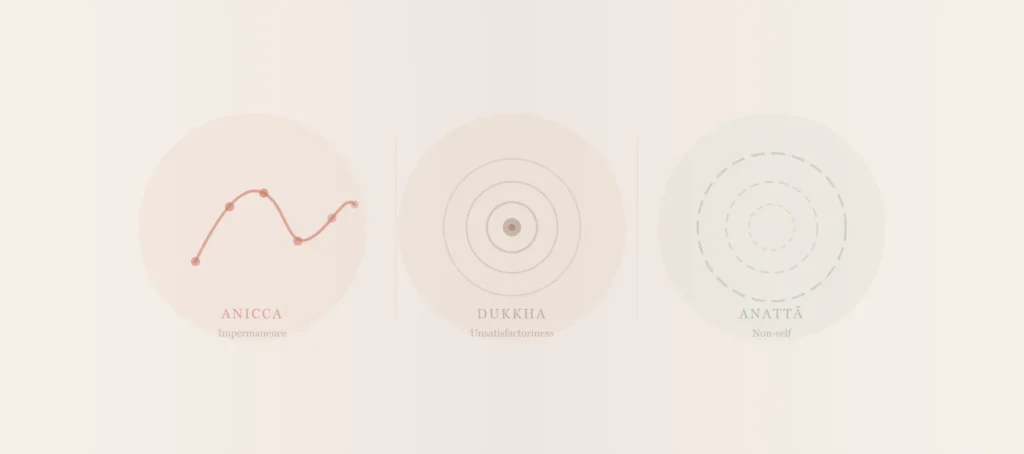
The First Mark: Anicca — Impermanence
Anicca means impermanence — the truth that all conditioned phenomena arise, persist for a time, and then pass away. This is not merely the observation that “everything changes eventually.” The Buddha pointed to a subtler level: even within what appears stable, there is constant flux. Thoughts arise and dissolve in milliseconds. The body replaces its cells. Emotions shift with conditions. What we call “a moment” is itself a rapid sequence of arising and passing.
In meditation, seeing anicca directly — watching thoughts arise and dissolve, sensations appear and fade — is one of the most profound experiences available to a practitioner. It dismantles the illusion that experience is solid and reliable, and it makes clinging feel obviously futile: you cannot hold onto a wave.
The Second Mark: Dukkha — Unsatisfactoriness
Dukkha is often translated as “suffering,” but this is too narrow. The Pali word encompasses three levels of unsatisfactoriness. The first is obvious suffering — pain, illness, grief, loss. The second is the suffering inherent in change — even pleasant experiences, because they are impermanent, carry within them the seed of future disappointment. The third, most subtle level is saṅkhāra-dukkha — the pervasive unsatisfactoriness that comes from being a conditioned being subject to the influence of ignorance and craving.
Understanding dukkha is not pessimism. The Buddha compared himself to a doctor — one who first accurately diagnoses the illness, not to depress the patient, but because diagnosis is the necessary first step toward cure. Seeing dukkha clearly, without denial and without despair, is the beginning of genuine healing.
Three Levels of Dukkha
Dukkha-dukkha: The suffering of ordinary pain — physical and mental anguish, illness, grief, aging, death.
Vipariṇāma-dukkha: The suffering of change — pleasant experiences are impermanent and inevitably give way to disappointment or craving for more.
Saṅkhāra-dukkha: The subtle, pervasive unsatisfactoriness of conditioned existence — the deep existential disquiet that underlies ordinary life, even in comfortable circumstances.
The Third Mark: Anattā — Non-self
Anattā — non-self — is perhaps the most radical and most liberating of the three marks. The Buddha taught that nowhere in the five aggregates (form, feeling, perception, mental formations, consciousness) is there anything that qualifies as a permanent, autonomous, unchanging self. What we call “I” is a dynamic process — a flowing stream of conditioned experience — not a fixed entity.
This teaching does not mean that we don’t exist, or that actions have no consequences, or that nothing matters. It means that the solid, separate, independent self we habitually assume ourselves to be is a construction — maintained by craving and ignorance — and not what we actually are. Seeing this clearly is the insight that, in the Theravāda tradition, leads directly to liberation.
Seeing the Marks in Daily Experience
The Three Marks are not abstract philosophy. They are present in every moment of experience, waiting to be noticed. A simple practice: when you find yourself resisting an experience, ask: “What am I holding onto? Is it permanent?” When you find yourself chasing pleasure, ask: “Will this truly satisfy?” When you feel defensive about your identity, ask: “Who is actually being defended?”
The Dhammapada puts it directly: seeing these characteristics with wisdom leads naturally to turning away from suffering — not as an act of renunciation or willpower, but as the natural consequence of clear seeing. When we see that clinging to what is impermanent is the source of pain, the clinging loosens on its own.