
New to Meditation?
You don't need any prior experience. Here's a simple introduction to get you started.
Your First Steps in Meditation
Find a quiet place
Sit in a comfortable position — on a cushion on the floor, or in a chair. Keep your back straight but relaxed. Close your eyes gently.
Bring attention to the breath
Simply notice the natural flow of your breath. Feel the air entering and leaving the body. Don't force or change the breath — just observe it.
When the mind wanders, return
The mind will wander — that's completely natural. Each time you notice it has wandered, gently bring it back to the breath. This returning is the practice.
Start with 10–15 minutes
Even a short daily practice has profound benefits. Start small, be consistent, and gradually extend as your concentration develops.
Essential Buddhism
The foundations of the Buddha's teaching — clearly explained for modern practitioners.

The Five Precepts (Pañcasīla)
The ethical foundation of Buddhist practice — guidelines for living harmlessly and mindfully in the world.
Read Article →
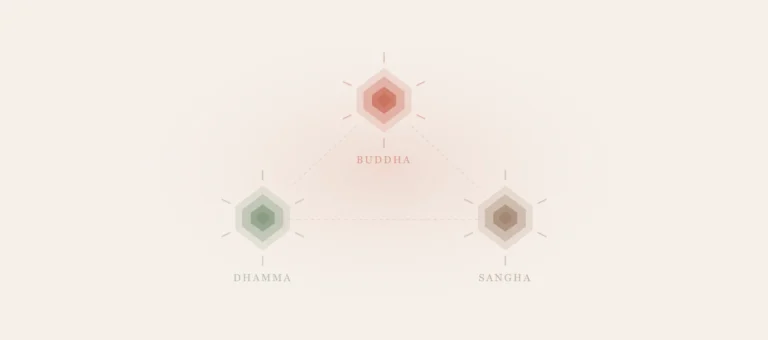
The Three Jewels (Tiratana)
Taking refuge in the Buddha, Dhamma, and Sangha — the foundational commitment of every Buddhist practitioner.
Read Article →

The Noble Eightfold Path
A clear guide to the Buddha's path to liberation — understanding, thought, speech, action, livelihood, effort, mindfulness, and concentration.
Read Article →

The Four Noble Truths
The Buddha's most fundamental teaching — the nature of suffering, its origin, its cessation, and the path to liberation.
Read Article →

The Four Brahmaviharās (Divine Abodes)
Loving-kindness, compassion, appreciative joy, and equanimity — the four divine abodes that purify the heart.
Read Article →

Loving-Kindness (Mettā) Meditation
Cultivate boundless compassion and goodwill toward yourself and all beings with this guided Mettā practice from the Pali Canon.
Read Article →Frequently Asked Questions
Not at all. The Buddha's teachings are for all human beings. Many of our community members are not Buddhist — they may be Christian, Muslim, Jewish, agnostic, or simply curious. You are welcome exactly as you are, with no expectation of conversion or commitment.
Theravada is the oldest surviving school of Buddhism, most prevalent in Sri Lanka, Thailand, Myanmar, and Cambodia. It follows the Pali Canon — the earliest recorded words of the Buddha. Other major traditions include Mahayana (East Asian Buddhism) and Vajrayana (Tibetan Buddhism). While all Buddhist paths share the goal of liberation from suffering, Theravada emphasizes direct practice of the original teachings.
Meditation itself is a mental training practice. While it originates within a Buddhist context, the practice of mindfulness and concentration is universal. Many people of all faiths find that meditation enriches rather than conflicts with their existing beliefs. We teach meditation in its original context while welcoming and respecting every practitioner's personal background.
Pali is the ancient language in which the Buddha's teachings were first written down and preserved in the Tipitaka (the Pali Canon). Learning key Pali terms helps practitioners connect directly with the original teachings and understand important concepts that are difficult to translate fully into English, such as 'dukkha', 'nibbana', and 'metta'.
Many practitioners notice benefits — such as reduced stress, better concentration, and a calmer mind — within the first few weeks of regular practice. The deeper benefits of insight and wisdom develop gradually over months and years of sustained practice. The Buddha compared meditation to farming: regular, patient effort yields a rich harvest over time.
"The mind is everything. What you think, you become."— The Buddha
Ready to begin?
Join us for a guided meditation session and experience the teachings directly. No preparation needed.