
What Are the Three Jewels?
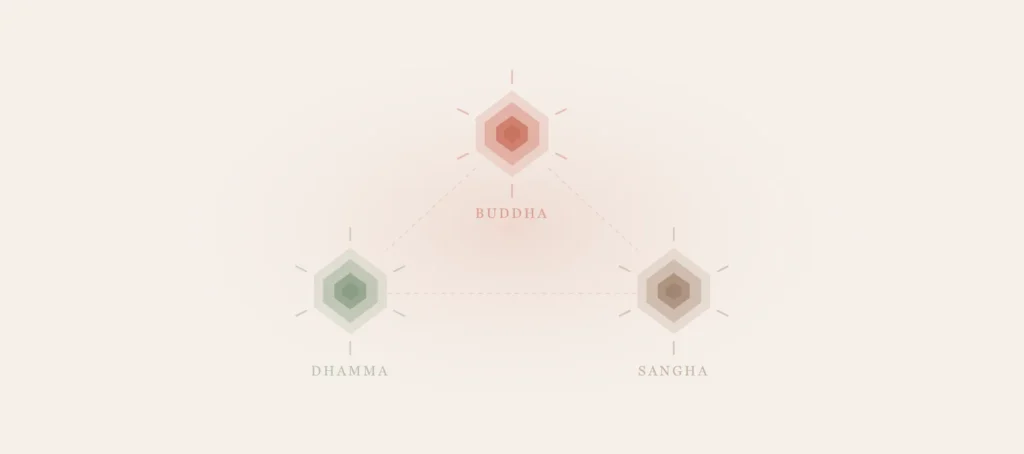
The Three Jewels — known in Pali as the Tiratana — are the Buddha, the Dhamma (his teachings), and the Sangha (the community of practitioners). Together they form the triple refuge that every Buddhist formally takes upon entering the path. They are called “jewels” because, like precious gems, they are rare, valuable beyond measure, and transformative to those who encounter them.
Taking refuge is not merely a verbal recitation. In the Pali Canon, the Buddha describes it as an act of genuine trust — placing confidence in the path because one has seen, at least partially, that it leads toward liberation from suffering.
The First Jewel: The Buddha
The word Buddha means “the Awakened One” — one who has woken up from the sleep of ignorance and seen reality as it truly is. Siddhattha Gotama, the historical Buddha who lived in northern India approximately 2,600 years ago, discovered the path to liberation through his own inquiry and practice. He did not receive a divine revelation; he earned awakening through sustained effort, and this is precisely what makes his example so powerful for practitioners.
Taking refuge in the Buddha does not mean worshipping him as a god. It means taking inspiration from his example — acknowledging that liberation from suffering is genuinely possible, because a human being achieved it. The Buddha himself repeatedly said: “What I have done, you can do.” Refuge in the Buddha is, at its core, confidence in human potential.
The Second Jewel: The Dhamma
Dhamma (Sanskrit: Dharma) refers to the teachings of the Buddha as preserved in the Pali Canon — the body of discourses, monastic rules, and philosophical analysis recorded by the early Sangha. More broadly, Dhamma refers to the truth of how things actually are: impermanent, interdependent, and without a fixed self at their core.
The Buddha described the Dhamma as a raft — useful for crossing the river of suffering, but not something to be carried on your head once you have reached the other shore. The teachings are medicine, not dogma. They are to be tested in direct experience, not accepted on blind faith. As the Buddha taught in the Kālāma Sutta: “When you know for yourselves — these things are wholesome, these things lead to welfare and happiness — then you should practice them.”
The Third Jewel: The Sangha
Sangha refers both to the monastic community of monks and nuns who have dedicated their lives to practice, and more broadly to the community of all Buddhist practitioners walking the path together. The Sangha is the jewel we often underestimate. Spiritual community is not a convenience — it is essential support for the journey.
When the Venerable Ānanda suggested to the Buddha that “good friendship is half of the holy life,” the Buddha corrected him gently: “Not so, Ānanda. Good friendship is the whole of the holy life.” The presence of sincere practitioners around us — people who share our values, our questions, our commitment — makes the path not just possible but joyful.
The Daily Recitation
Traditional practitioners recite the refuge formula each morning and evening, in Pali:
Buddhaṃ saraṇaṃ gacchāmi — I go for refuge to the Buddha.
Dhammaṃ saraṇaṃ gacchāmi — I go for refuge to the Dhamma.
Saṅghaṃ saraṇaṃ gacchāmi — I go for refuge to the Sangha.
This recitation is not magic — it is a daily renewal of commitment, a conscious act of aligning one’s direction with the path of awakening. Over time, this simple ritual becomes a powerful anchor for practice.
How Taking Refuge Transforms Practice
Refuge gives the practice a direction and a home. Without the Three Jewels, meditation is just a technique for relaxation. With them, it becomes part of a coherent path toward liberation. The Buddha taught that genuine refuge arises when one has understood, at least intellectually, the Four Noble Truths — that suffering exists, that it has a cause, that it can end, and that there is a path that leads to its ending.
In the Theravada tradition upheld at Mahamevnawa, the taking of refuge is always accompanied by the Five Precepts — the ethical guidelines that create the conditions for meditation to flourish. Refuge and precepts together form the foundation: the ground upon which all higher practice is built.
Historical Context in the Pali Canon
The Three Jewels appear throughout the Pali Canon from the very beginning of the Buddha’s teaching career. After his enlightenment, the Buddha traveled to the Deer Park at Isipatana (modern-day Sarnath) and delivered his first discourse — the Dhammacakkappavattana Sutta — to five ascetics. Upon hearing the teaching, Koṇḍañña declared “Whatever is subject to origination is subject to cessation” and thus became the first member of the human Sangha, having understood the Dhamma for himself.
The Buddha rejoiced: “Koṇḍañña knows! Koṇḍañña knows!” — and with that moment, all Three Jewels were complete for the first time in human history. The teaching had been given, heard, and verified by direct experience. This is the model the tradition has preserved ever since.